Why Regular Tree Trimming Matters in Houston's Humidity
Fast growth and thick canopies are great for shade, until wind, weight, and moisture turn them into a problem.
September 8, 2026 · 4 min read
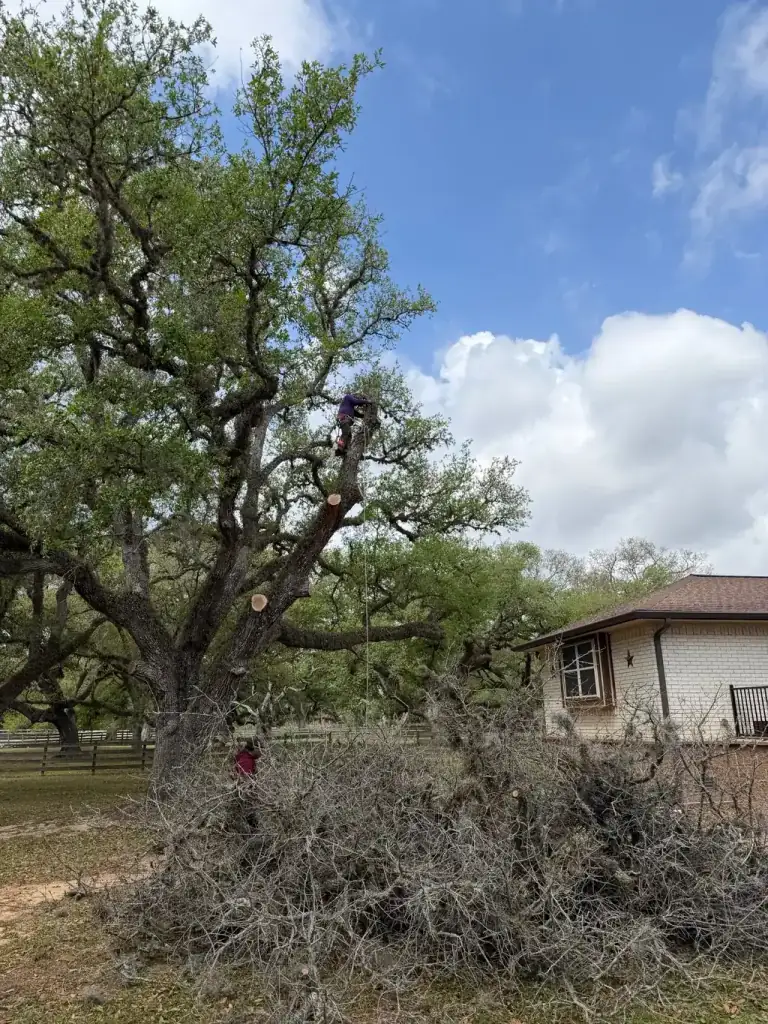
Trees in Houston don't grow like trees in drier, cooler parts of the country. Between the long growing season, the humidity, and the rain, a healthy tree here can push out a surprising amount of new wood in a single year. That's good news if you want shade fast. It's less good news if that growth goes unmanaged, because a canopy that thickens up unchecked turns into extra weight, extra wind resistance, and extra places for moisture to sit against the bark. Regular trimming is how you keep the good part of that growth without the parts that cause trouble.
Dense canopies catch wind they shouldn't
A tree with a well-thinned canopy lets wind pass through it. A tree that's been left alone for years builds up so much leaf and branch density that it acts more like a sail. During a Gulf Coast storm, that's the difference between a tree that flexes and sheds a few small branches, and one that loses a major limb or goes over at the roots. Thinning the canopy so air can move through it is one of the most effective things we do, and it's a lot cheaper than dealing with storm damage after the fact.
Moisture and deadwood are a bad combination
Humidity is great for growth, but it's also great for decay once a branch dies. Deadwood that sits in a damp canopy breaks down faster than it would in a dry climate, which means it becomes brittle and prone to dropping sooner than homeowners expect. Clearing deadwood on a regular schedule, rather than waiting until it's obviously a hazard, keeps that risk out of your yard and off your roof.
What a seasonal trimming plan actually covers
We don't approach every tree the same way twice. Our crews look at canopy thinning to reduce wind load, deadwood removal for safety, and overall shape so the tree keeps growing the way it should rather than lopsided or overloaded on one side. One thing we won't do is top a tree, cutting it back hard to stubs. It might look like a fix, but topping forces a rush of weak, poorly attached regrowth that's far more likely to fail later, and it can shorten the tree's life. Real trimming works with the tree's structure, not against it.
- Canopy thinning so wind passes through instead of catching the whole crown
- Deadwood removal before it becomes brittle and unpredictable
- Shape and structure work so weight stays balanced across the tree
- Seasonal plans timed around Houston's growing season, not a generic calendar
- No topping, ever, since it trades a short-term look for long-term weakness
Timing it around storm season
Because Houston's storm season overlaps so directly with the growing season, timing matters. A tree that's been thinned and cleared of deadwood before the heavy weather arrives is simply a safer tree to have near your house. Trimming does more than lower the risk, too. It keeps a tree healthy enough to carry next year's growth without overextending itself.
Why this isn't really a DIY job
It's tempting to handle small trimming with a pole saw from the ground, and for genuinely low, easy-to-reach branches, that's fine. The trouble starts once a cut requires getting up into the canopy, because that's where the real judgment calls live. Knowing where to cut relative to the branch collar so the tree heals cleanly, reading which limbs are actually load-bearing for the rest of the crown, and working safely off rope rather than a ladder are all things that take real training. A poorly placed cut doesn't just look rough, it can leave an opening for decay to get into wood that was otherwise healthy, which defeats the purpose of trimming in the first place.
There's also the humidity factor again. Every open cut is a potential entry point for the fungal and pest issues that thrive in our climate, so how a cut is made matters almost as much as whether it's made at all. A clean, properly placed cut heals over. A ragged one, or one made in the wrong spot, tends to stay an open wound far longer than it should.
A crew that knows what Houston growth looks like
Tree Care Professional has been trimming trees across Houston and the surrounding towns since 2001, and our team spans everyone from climbers and machine operators to the people who answer the phone. Safety comes first on every job, and every visit starts with a free, honest estimate. If it's been a while since your trees had a real look, that's usually the first sign it's due.
Tree Care Professional — (281) 704-6828
Call (281) 704-6828More articles
Three Signs a Tree Needs Removing, Not Just Trimming
How to tell the difference between a tree that needs a haircut and one that needs to come down.
Pruning for Healthier Growth: Why Late Winter to Early Spring Works Best in Houston
The right cut at the wrong time of year still stresses a tree. Here's why the calendar matters.